- Home
- News
- XPENG Accelerates Intelligent Driving in Europe with AI-Driven VLA 2.0 Deployment and OTA Updates
XPENG Accelerates Intelligent Driving in Europe with AI-Driven VLA 2.0 Deployment and OTA Updates
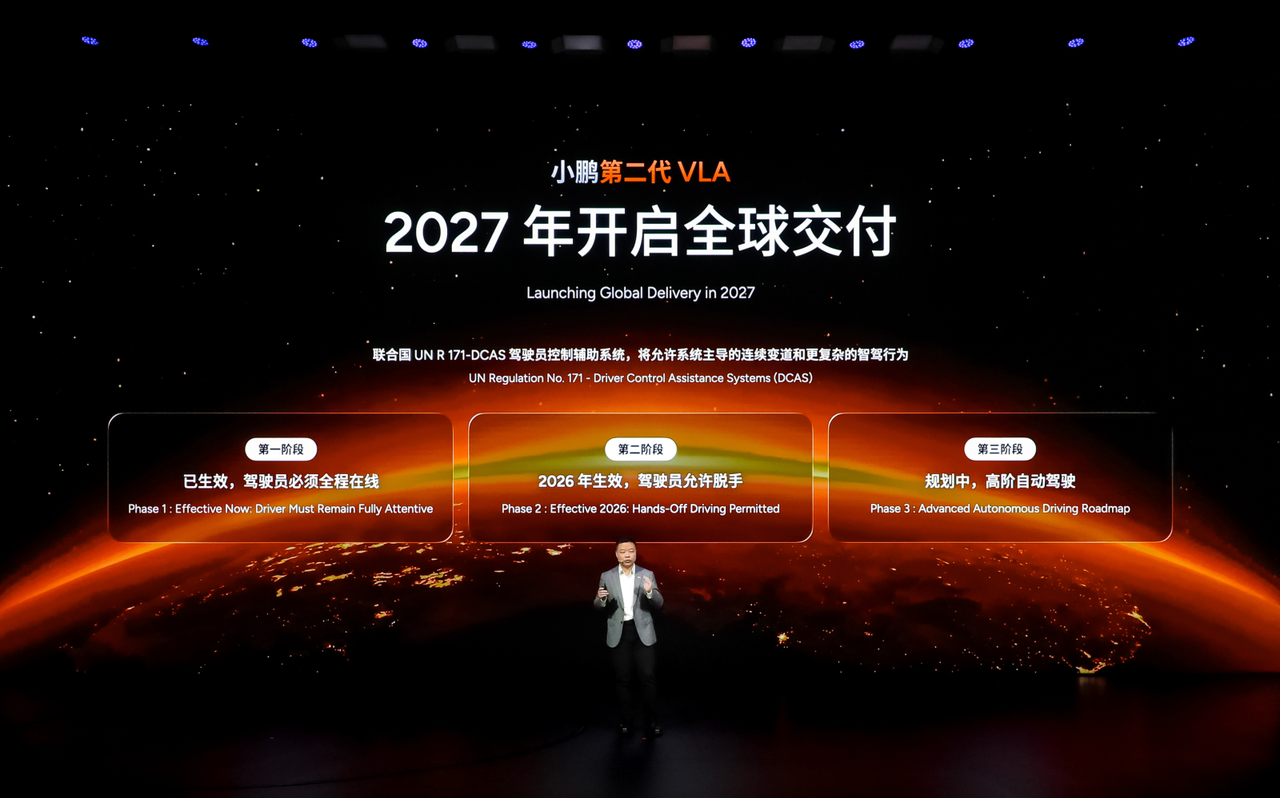
Amsterdam, 2 March 2026 – XPENG, a global technology company leading in AI-driven smart electric vehicles and innovation, announces that its second-generation Vision-Language-Action autonomous driving system (VLA 2.0) will begin global delivery in 2027, with Volkswagen designated as the inaugural launch partner in the Chinese market. At the same time, XPENG is honouring its commitment to technological inclusivity. This March, the company will begin rolling out the XOS 5.8.7 over-the-air (OTA) update to existing vehicle owners in Europe. This dual-track approach advances XPENG toward the goal of Level 4 autonomous driving, while enabling vehicles already on the road to continuously improve their intelligence.
XPENG VLA 2.0 Powers Full-Scenario Intelligent Driving
At XPENG’s ‘The Future’ VLA technology launch event today, the company showcased VLA 2.0’s architecture and outlined its global rollout strategy.
The evolution to VLA 2.0 represents a major leap in AI-driven driving. Unlike traditional VLA models that rely on a sequential vision‑language‑action pipeline, VLA 2.0 uses an end-to-end vision-to-action architecture that removes intermediate language-based translation layers and directly converts perception into driving decisions. This design reduces dependence on high-definition maps and rigid rules, allowing the system to interpret complex environments and make faster, human-like driving actions.
XPENG aims to deliver a smooth and worry-free intelligent driving experience for every family. Early tests in dense urban and mixed-traffic conditions have shown robust performance, with a 23% improvement in driving efficiency. The system can identify erratic vehicles, navigate accident scenes, yield to small animals, start from a standstill, and handle diverse real-world conditions, including campus lanes, rural dirt roads, non-navigable routes, and potholes, delivering a genuine “full-process assisted driving” experience.
Mr He Xiaopeng, Chairman and CEO of XPENG, said: “XPENG’s VLA 2.0 is the first version designed to achieve full autonomous driving and will iterate at an unprecedented pace. We believe that full autonomy will arrive within the next one to three years, making autonomous driving a natural part of people’s daily travel.”
VLA 2.0 Launches in China with Robotaxi Tests and Extended Volkswagen Partnership
The deployment of VLA 2.0 will begin in China, where XPENG’s Robotaxi vehicles equipped with the system have entered supervised public-road testing, with trial operations scheduled to commence later this year.
XPENG also announces that Volkswagen is the first customer and commercial partner to adopt the VLA 2.0 intelligent driving system in China.
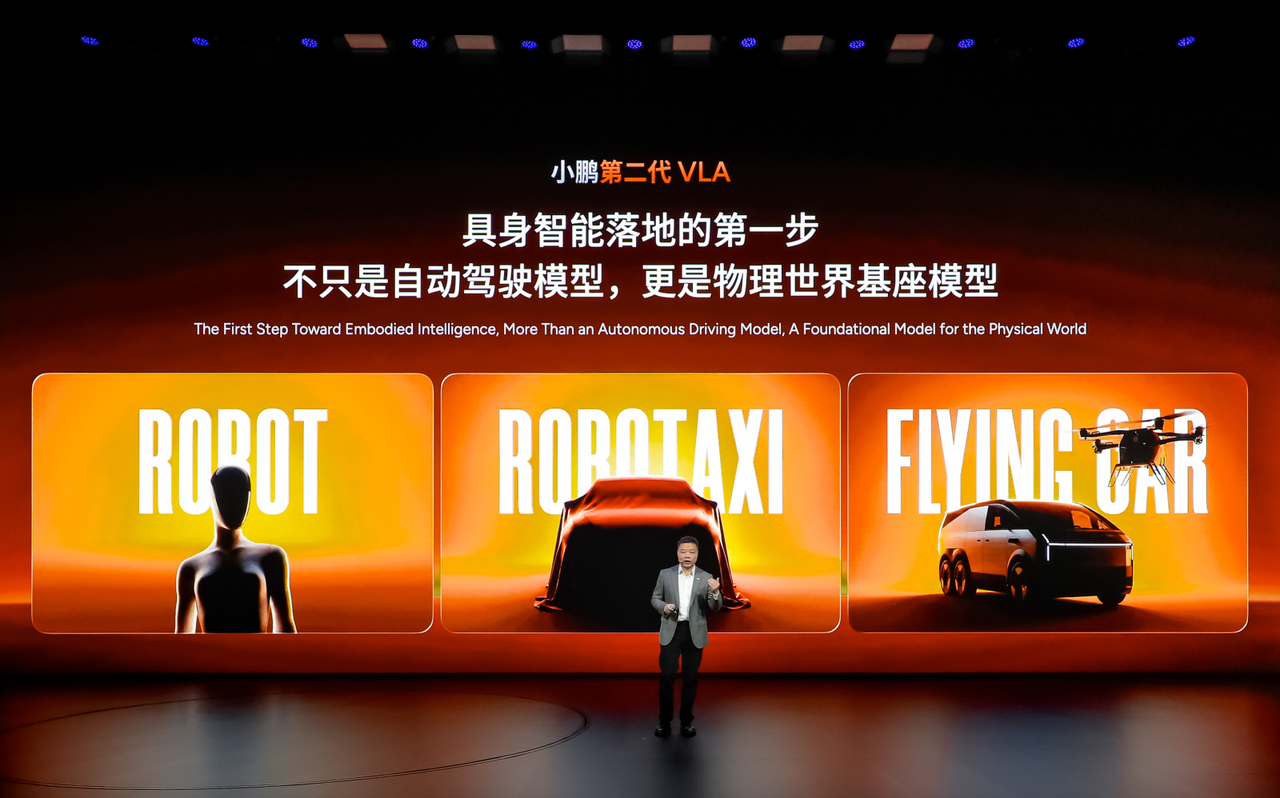
Beyond passenger vehicles, the AI foundation model powering VLA 2.0 is designed as a versatile platform across multiple embodied AI systems, including Robotaxi fleets, humanoid robots, and modular flying vehicles. These initiatives form part of XPENG’s broader Physical AI strategy, which aims to build a unified AI foundation capable of powering intelligent machines operating in real-world environments.
XPENG Targets 2027 for the Global Debut of VLA 2.0
As part of its global rollout, XPENG will soon begin overseas road validation of VLA 2.0, focusing on challenging international driving conditions.
Aligned with the forthcoming United Nations No.171 DCAS (Driver Control Assistance Systems) regulation, VLA 2.0 is designed to support system-initiated continuous lane changes and more advanced intelligent driving manoeuvres, enabling a broader range of assisted driving functions under evolving regulatory frameworks.
XPENG targets global deployment of VLA 2.0 by 2027. The system’s capabilities will be activated in each market upon regulatory approval, reflecting its design in line with evolving international standards.
XOS 5.8.7 OTA Upgrade Enhances Current Vehicles
While advancing toward the VLA 2.0 era, XPENG remains committed to enhancing the vehicles on roads today. Starting from early March, the company will launch the Early Access Program for XOS 5.8.7, with public rollout beginning later this month.
This latest update delivers meaningful refinements for daily European driving. Optimisations to Adaptive Cruise Control (ACC) and Lane Centring Control (LCC) reduce unnecessary deceleration and eliminate small-amplitude steering wheel oscillations on straight roads, resulting in a smoother, more natural driving experience. Additional enhancements include improved system stability, stronger CarPlay and Android Auto connectivity, optimized interface language displays, and faster OTA update speeds.
With XOS 5.8.7, XPENG reinforces that technological progress extends beyond new model launches, reflecting its commitment to enhancing vehicles already on the road and advancing its long-term intelligent driving strategy.
Disclaimer:
- This press note includes future statements.
- VLA 2.0 remains a supervised intelligent driving system, and the commercialisation of higher levels of automation will progress in accordance with evolving regulatory frameworks around the world.
- The company did not disclose a specific timeline for fully autonomous commercial deployment but noted that intelligent driving capabilities are expected to expand progressively as global regulatory environments mature.
- The system is powered by XPENG’s proprietary Turing AI chip, which provides up to 2,250 TOPS of effective computing power per chip. With multiple chips deployed in each vehicle, the platform significantly increases model inference efficiency and enables the deployment of large-scale AI models in production vehicles.